Breaking Down Barriers to Marine Science Careers
Marine science is far from reflecting the diversity of the wider UK. Correcting this is a long process. The first step is to understand where we are now. What prevents children of primary school age (4-11 yrs) from seeing themselves as ocean explorers? What are the barriers to those who do? The second step is to identify ways in which their aspirations can be widened and the barriers removed.
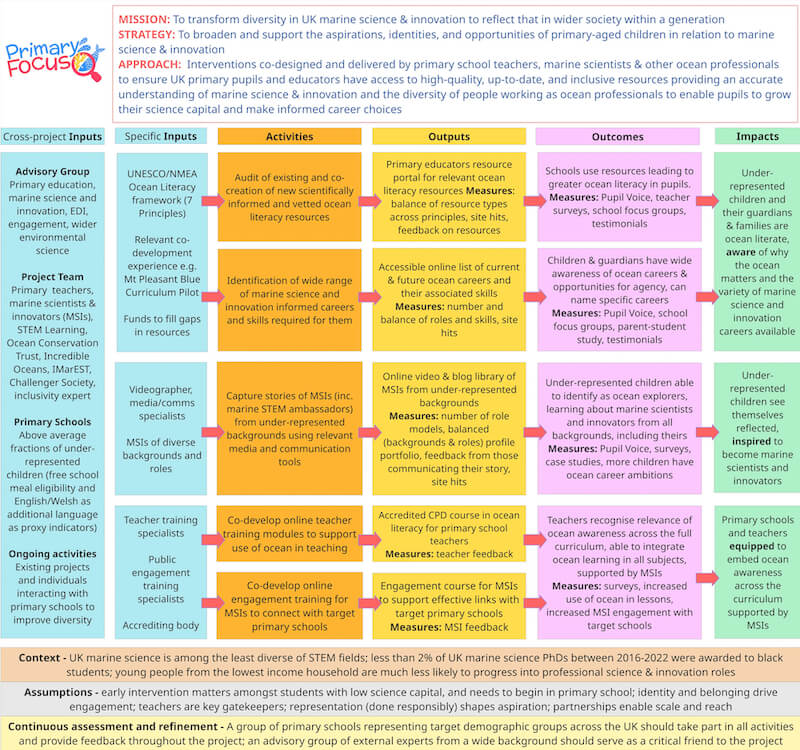
Primary Focus will develop a map - a Theory of Change - to take us from the low diversity situation that marine science finds itself in now, to a future where primary school children of all backgrounds recognise what they can offer to marine science, aspire to do so, and can visualise pathways into marine jobs.
We have assembled a team that will provide a 360 degree perspective on the problem, including primary school teachers, marine scientists, organisations focussed on marine science and technology education and outreach, a local education authority and representatives of national and international networks of marine researchers and employers.
By using questionnaires, circulated to the teaching and research communities through well-established networks, Primary Focus will collate information to build this map. A workshop combining the core team and additional teachers will assemble a draft, making it available for feedback from anyone in those communities once more. In this way, Primary Focus will draw on experience from across backgrounds and the UK to develop a Theory of Change that can achieve its aim.
Relevant online resoures
- ProBleu Resources Science Stories
- STEM Learning Ocean Resource Collection primary
- Encounter Edu primary resources
- Using technology for marine research. Follow the Glider JERICHO Project
- Ocean Literacy for All - A toolkit. IOC/UNESCO & UNESCO Venice office, Paris (IOC Manuals and Guides, 80)2017. F. Santoro et al.[eds]

Dr Adrian Martin, NOC
July 2025 – March 2026
NERC Opening up the Environment

Project Aim
Primary Focus has the ambitious long term aim of transforming diversity in marine science to reflect that in wider society within a generation. It will achieve this by focussing on how the aspiration of primary school children to work in marine related areas can be elevated.


Organisations Involved in Primary Focus
- Mount Pleasant School, Southampton
- Plymouth Marine Laboratory
- Scottish Association on Marine Science
- U. Southampton
- U. Portsmouth
- The Challenger Society
- Incredible Oceans
- Ocean Conservation Trust
- IMarEST
Survey Results
We need to move from the current lack of diversity in marine science and innovation, to a future where primary school children of all backgrounds recognise what they can offer to marine science, aspire to do so, and can visualise pathways into marine jobs.
Primary Focus aims to construct a plan to achieve this, mapping out the steps needed to achieve that long-term goal.
Two surveys were carried out to gather evidence to help create that plan. You can see a summary of the results here:
Theory of Change
We need to move from the current lack of diversity in marine science and innovation, to a future where primary school children of all backgrounds recognise what they can offer to marine science, aspire to do so, and can visualise pathways into marine jobs.
Primary Focus has constructed a plan to achieve this. We would very much value your feedback on that plan. To give feedback on the plan, shown below, please complete this short form: Feedback on Theory of Change.
A Theory of Change maps out the steps needed to achieve a long-term goal. In a single page, it shows the different activities required, their outcomes, the people who need to contribute, those who will be the beneficiaries and how success in moving towards that long term goal will be measured.
This Theory of Change was co-developed by a team of primary school teachers, ocean researchers, engagement specialists and national organisations for STEM education, marine research and marine industry. It has been funded by the NERC Opening up the Environment programme.