![National Oceanography Centre [logo]](/themes/NOC8X-main/logo.svg)
An international team led by Dr Covadonga Orejas, a senior researcher at the Gijón Oceanographic Center of the Spanish Institute of Oceanography (IEO-CSIC), Prof Veerle Huvenne, a Research Leader at the National Oceanography Centre (NOC), and Prof Jacob González-Solís, a professor at the University of Barcelona, has published the first focused study integrating all existing knowledge about the seamounts of the Cabo Verde archipelago, including biodiversity, ecological role, and socioeconomic relevance.
These volcanic formations, comprising at least fourteen large seamounts and numerous smaller elevations, stand out as true oases of life in the deep ocean by concentrating nutrients and shaping current circulation, thereby supporting exceptional biological diversity from microorganisms to deep-sea coral sponge communities, sharks, sea turtles, seabirds, and cetaceans. Their position between the temperate North Atlantic and the tropical South, further enhances their productivity and ecological connectivity, reinforcing their role as hotspots of marine life.
“The seamounts of Cabo Verde are essential refuges for many species, and this study highlights the importance of a multidisciplinary approach to understanding the relationships between geology, oceanography, and biology, as well as the need to include socio-economic aspects in this type of review work,” explains Dr Covadonga Orejas.
“Understanding how seamounts function is key to planning their protection and ensuring the sustainable use of their marine resources,” adds Prof Veerle Huvenne, a senior author on the paper.
"From the perspective of a Civil Society Organisation, knowledge about seamounts is crucial to strengthening marine spatial management and promoting the conservation of natural resources in Cabo Verde. These deep-sea ecosystems act as key biodiversity areas and provide strategic information to guide public policies and marine spatial planning. In a country where protected areas are currently limited to coastal zones, the study of seamounts paves the way for more integrated and comprehensive conservation efforts. This knowledge also enhances the capacity of organisations and local communities to actively participate in the governance and sustainable protection of ocean resources.", notes Herculano A. Dinis, Executive Director Associação Projecto Vitó in Cabo Verde.
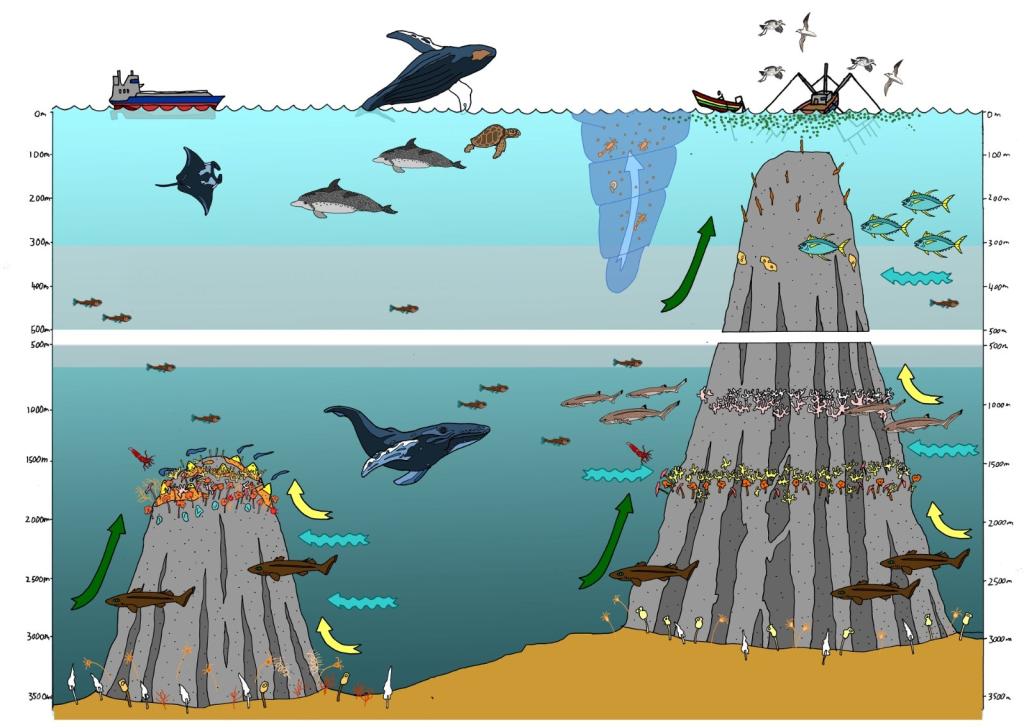
Benthic communities of Cadamosto Seamount by Autun Purser
The article analyses not only the biological richness of these ecosystems but also the associated human uses, especially artisanal and industrial fishing, and the emerging risks linked to maritime traffic and the potential expansion of deep-sea mining.
“These seamounts are critical to the health and wellbeing of Cabo Verde’s oceans and people. Their cultural and economic importance is reflected in strong community support for their conservation which underlines the necessity for Cabo Verde’s Government to develop a sustainable blue economy and achieve its international treaty targets” noted Gillian Ainsworth, Postdoctoral Researcher based in the EqualSea- CRETUS Lab at the University of Santiago de Compostela.
The seamounts of Cabo Verde thus represent enclaves of exceptional ecological and strategic value for marine conservation. In this context, the study underlines the importance of incorporating them into national marine spatial planning strategies and the country's networks of marine protected areas. Several studies have demonstrated that many of these seamounts meet the international criteria for recognition as Vulnerable Marine Ecosystems (VMEs) and Marine Ecologically or Biologically Significant Areas (EBSAs), due to their key role in productivity, ecological connectivity, and the maintenance of ocean biodiversity.
“As a State Party to the 30x30 Commitment for Biodiversity and the High Seas Treaty, Cabo Verde has the opportunity to position these seamounts as priority areas for conservation and sustainable management, thus reinforcing its regional leadership in the protection of the marine environment and in compliance with international objectives for biodiversity conservation and sustainable development,” explains the other senior author on the publication, Jacob González-Solís, Professor at the Biodiversity Research Institute (IRBio) and the Department of Evolutionary Biology, Ecology and Environmental Sciences at the University of Barcelona.
The study involved over 40 researchers from 20 institutes across Europe, Africa, and the Americas, and was supported by a wide range of funding sources (full list of authors, affiliations and funding below). IEO-CSIC, the main coordinator of the work, was primarily funded by the European projects iAtlantic, which concluded in 2024, whereas the UB coordination was mainly funded by the European project REDUCE. The Hanse Wissenshaftskolleg Institute for Advanced Study, through its Study Group led by Covadonga Orejas and Veerle Huvenne, also contributed to this review.
Full author list:
Covadonga Orejas a,b,*, Beatriz Vinha b,c,d,e , Gillian B. Ainsworth f,g , Sarah Saldanha c,d , Teresa Militão h , Christian Mohn i , Thor H. Hansteen j , Sara S. Ratão k,l,m,n,o , Henk-Jan Hoving j, Teresa Amaro p , Dominique M.J. Anderson q, Deusa Araújo r, Ana Mafalda Correia s , Simon Berrow t , Herculano A. Dinis r, Rui Freitas u, Evandro Lopes u , Vanessa Lopes r,v , Pedro Lopez w, Thais Macedo n,x, David March y,z , Samir Martins w , Diana M. Matos aa, Fernando Medrano c,d , Tommy Melo ab, Gilda Monteiro ac, Angela Mosquera Giménez ad,ah, Vitor H. Paiva h , Nuno Queiroz k,m, Florian Schütte j,ae , Julian B. Stauffer j , Albert Taxonera af , Celine Van Weelden c,d, Jacob González-Solís c,d , Veerle A.I. Huvenne b,ag Seamounts of Cabo Verde: a review of their ecological and economical significance, anthropogenic impacts, and conservation needs. Progress in Oceanography 103579.