![National Oceanography Centre [logo]](/themes/NOC8X-main/logo.svg)
Due to rising marine heatwave (MHW) activity in UK waters a team of UK scientists led by Dr. Zoe Jacobs at the National Oceanography Centre (NOC), have identified the key questions we urgently need to answer to develop a coordinated national response.
The 40 priority questions must be addressed to improve our understanding of MHWs, the impacts in UK waters and help the nation prepare for future events. This marks the first coordinated national strategy to address the accelerating threat of MHWs to ecosystems, the blue economy and coastal communities.
MHWs are periods of unusually warm sea temperatures, recognised as one of the fastest emerging climate-related drivers of change in the ocean. They can affect everything from plankton and fish stocks to coastal tourism, food security and mental health.
The unprecedented marine heatwave surrounding the UK and Ireland in summer 2023 exposed critical gaps in our understanding of how these events unfold in UK waters and what they mean for society.
Using diverse interdisciplinary expertise, spanning ecology, climate science, economics, governance, human health and technology, the team’s questions provide a definitive roadmap for researchers, policymakers, and funding bodies. This offers evidence-based direction for future investment and long-term climate resilience planning.
While the majority of impacts reported globally have been negative, the authors note that short-term opportunities may emerge in UK waters. For example, through shifts in species distribution that benefit specific fisheries or tourism sectors. Understanding which species or industries are likely to experience risk or opportunity is essential for developing realistic adaptation measures.
Dr Zoe Jacobs, lead author, said: “Marine heatwaves represent one of the most urgent and least understood climate threats facing UK seas. By working across disciplines and sectors, we’ve identified the key questions we must answer to protect marine ecosystems, safeguard coastal communities and strengthen our blue economy. This roadmap gives researchers, funders and policymakers a clear direction of travel and highlights the need for coordinated national action. Preparing for marine heatwaves is no longer optional, it is essential for ensuring a resilient ocean future.”
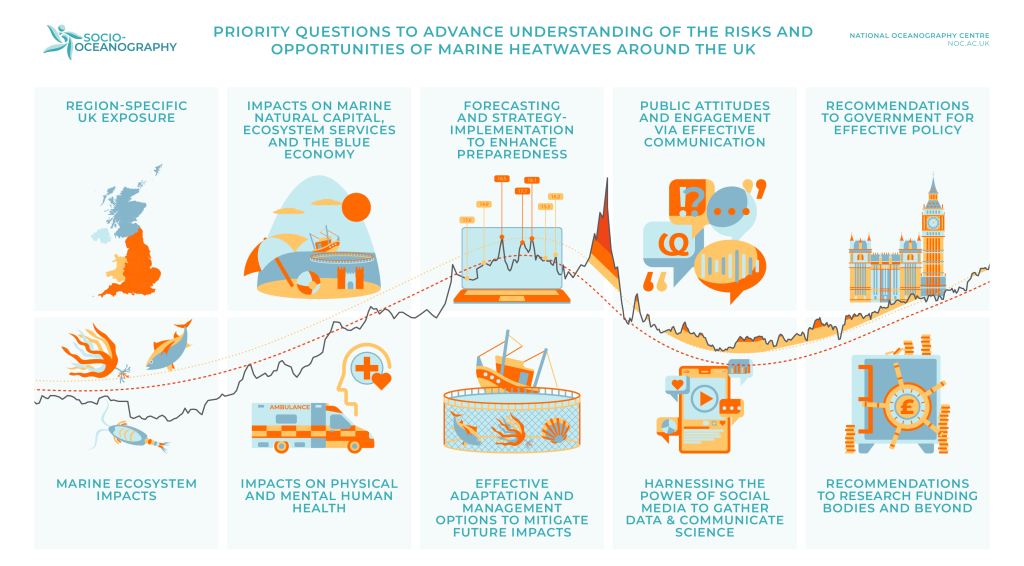
Themes for research questions and recommendations
A call for a UK-wide monitoring and forecasting strategy
One of the central recommendations of the study is the development of a national monitoring system capable of detecting emerging heatwaves, tracking their ecological effects and comparing conditions against historical baselines. Continuous, long-term data collection will be vital to identifying vulnerable regions, assessing ecosystem responses and supporting emergency management.
Expanding citizen science programmes, as well as using social media to gather observations and improve public ocean literacy, could significantly strengthen this system.
The study also emphasises the need for increased investment in innovative marine technologies, such as rapidly deployable autonomous sensors, and improved UK-based forecasting tools. Integrating real-time data with long-term climate projections will help identify future hotspots and climate refuges, guiding evidence-based decisions in sectors such as fisheries, aquaculture and marine spatial planning.
The authors highlight several recommendations to support national preparedness, including:
- Incorporating MHW risks in the UK’s next Climate Change Risk Assessment.
- Integrating MHW impacts into marine, fisheries, aquaculture and conservation policy frameworks.
- Implementing coordinated evidence collection across government sectors during MHW events.
- Focusing on vulnerable regions and blue economy sectors.
- Building a collaborative national network to guide response and adaptation.
These mechanisms are described as essential for ensuring that scientific evidence is translated into meaningful, timely action.
Click here to read the study in full
Notes to Editors
The Socio-Oceanography workshop that generated the priority questions was hosted by NOC in March 2024, with financial support from NERC grant CLASS (NE/R015953/1).
Further author contributions and manuscript development were supported by AtlantiS (NE/Y005589/1), TerraFIRMA (NE/W004895/1), SWEEP (NERC NE/P011217/1), and the UKRI Future Leaders Fellowship (MR/X023214/1).