![National Oceanography Centre [logo]](/themes/NOC8X-main/logo.svg)
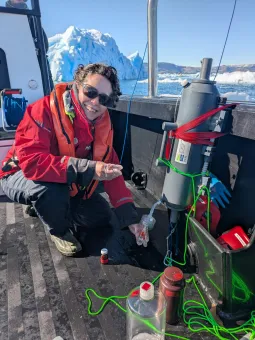
The Arctic is changing, and scientists at the National Oceanography Centre (NOC) are working to uncover what that means for life beneath Greenland’s waters.
NOC researchers have been studying the links between dissolved organic carbon (DOC), phytoplankton and bacteria as they aim to understand how melting glaciers shape these relationships.
In Summer 2025, the NOC team - led by Dr Elena Garcia-Martin – joined an Augmentum-funded expedition aboard MY Akula to survey three fjords along Greenland’s east and southwest coasts.
Across 22 sampling stations, they collected data monitoring temperature, salinity, nutrients and organic matter.
Early findings, published as part of a six-month report, reveal distinct differences between fjords fed by marine‑terminating glaciers and those fed by land‑terminating glaciers.
Chlorophyll‑a levels (a marker for phytoplankton) were higher in the southwest, while DOC concentrations peaked near glacial rivers, highlighting strong inputs from meltwater.
The team also observed layered waters, with cold, fresh surface flows sitting above deeper, saltier Atlantic water. Using fluorescence spectroscopy and PARAFAC modelling, they identified four types of dissolved organic compounds, offering clues about carbon’s origins.
Images from the onboard PlanktoScope demonstrated relatively low plankton abundance, with slightly richer communities in land‑terminating fjords. Matching the visual observations with eDNA sequencing will help to develop a fuller picture of biodiversity.
Discover more: Exploring DOC in Greenland: Six Months of Discovery Report