![National Oceanography Centre [logo]](/themes/NOC8X-main/logo.svg)
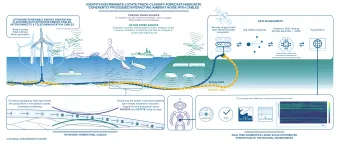
A single fibre optic cable can generate up to 86 terabytes of ocean data per day, offering unprecedented insight into underwater environments.
A team of scientists led by Professor Mohammad Belal at the National Oceanography Centre (NOC) has demonstrated how existing subsea fibre optic cables can be transformed into high-resolution sensors capable of monitoring the ocean in real time. The findings, published in Scientific Reports, mark a major step forward in continuous ocean observation, with early warning capabilities.
The research forms part of the SEALS (Submarine noise Evaluation & Analytics using Low-cost Sustainable-sensing) project, delivered through the European Multidisciplinary Seafloor and Water Column Observatory (EMSO) Physical Access Programme. By using a 28-kilometre subsea cable in the Western Ionian Sea, the team effectively turned the entire cable into a continuous array of thousands of virtual sensors, capturing detailed acoustic and physical signals across the seafloor.
How the system works
At the heart of the system is an onshore ‘interrogator’, which sends pulses of light along the fibre optic cable. External events, such as seismic tremors, ocean currents, vessel movements, or passing marine mammals, disturb the cable and alter the returning light signal. By analysing these changes, researchers can detect, locate, and classify underwater events with remarkable precision.
Professor Belal said: “This work shows how we can transform existing subsea infrastructure into powerful, continuous ocean observatories. By combining advanced optical sensing with bespoke data analytics, we are able to distinguish a wide range of underwater processes in real time. This opens entirely new possibilities for monitoring and understanding the ocean at scale.”
Tackling the ocean ‘Big Data’ challenge
The DOFS system used in the SEALS project generates up to 86 terabytes of data per day, equivalent to streaming millions of hours of video. To extract meaningful insights, the team has developed advanced algorithms capable of automatically detecting and classifying distinct ‘vibrational signatures’ within the data. These allow scientists to differentiate between submarine geohazards, vessel traffic, and biological activity, creating a continuous, high-resolution view of the ocean environment.
The research took place at the EMSO Western Ionian Sea Facility, operated by INGV, INFN, and CNR-ISMAR, located off the coast of Sicily. This region, dominated by Mount Etna and shaped by tectonic activity, provides a dynamic environment for testing the system. The researchers were able to capture signals from seismic activity, underwater landslides, ocean turbulence, and marine life movements.
Data collected by the fibre optic system are validated against conventional instruments already deployed at the site, including seafloor seismometers, hydrophones, and oceanographic moorings, ensuring accuracy and reliability.
By leveraging existing infrastructure with cutting-edge sensing and analytics, the study demonstrates a scalable, cost-effective method for continuous ocean monitoring. This capability provides scientists with unprecedented insights into underwater processes, natural hazards, and marine ecosystems. The approach is expected to play a critical role in supporting climate research, ocean policy, and sustainable management of marine environments.
The SEALS project is a collaboration between the National Oceanography Centre (UK), Scripps Institution of Oceanography, Woods Hole Oceanographic Institution, University of Southampton, and University of Edinburgh. The study highlights how international partnerships, combined with innovative use of existing infrastructure, can transform how we observe and understand the ocean.