![National Oceanography Centre [logo]](/themes/NOC8X-main/logo.svg)
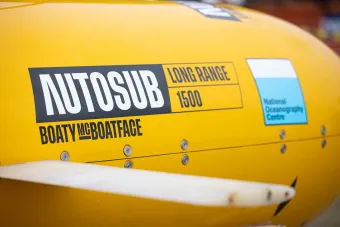
Second year Marine Science students at the University of Liverpool are gaining real-world experience through a project focused on researching and analysing data from the National Oceanography Centre (NOC)’s Autosub Long Range (ALR) vehicles - also known as Boaty McBoatface.
For the past four years, second year Marine Science students at the University of Liverpool have taken part in an immersive, industry-led project delivered in collaboration with NOC, with expert staff joining them on campus to share their specialist knowledge and provide exclusive access to NOC’s POLPRED tidal current and elevation software.
Working in teams, students develop detailed mission scenarios demonstrating how autonomous underwater vehicles (AUVs) such as the ALR can be applied to tackle real-world environmental and industrial challenges in the marine sector.
The ALR’s ability to conduct long-duration missions of two to three weeks, collecting high-resolution ocean data and imagery without the cost or carbon footprint of a large research vessel, makes it an ideal platform for this learning.
Supported by NOC experts, they also explore how complex ocean data can be visualised through dashboards.
Working across three challenge areas - Patrolling Marine Protected Areas, Carbon Capture and Storage, and Renewable Energy - each group designs a detailed brief for a target organisation in areas relevant to the set challenges. Recent supporting partners have included Natural England (Marine Protected Areas) and HyNet (Carbon Capture).
Students engage with experts across a range of challenge areas before undertaking their own in-depth research to analyse the capabilities of the ALR and the data it can generate to support commercial goals and strengthen links between science and industry. Collaboratively, they identify the key challenges facing their chosen organisation and explore how ALR-derived data could enhance operations, improve efficiency, or meet currently unmet needs. They also design a clear, purpose-built dashboard to demonstrate how this data would be visualised and applied in practice.
The project concludes with a professional group presentation to peers, NOC staff, and external industry representatives.
Layton Quinton, Head of Marine Information Products and Services at NOC, said: “This is the fourth year we have been running this programme. It has grown into a valuable exercise using the latest technology to gather and visualise ocean data for commercial and not just research purposes, which is helpful for students thinking about using their skills with an employer when they leave.
“Working in partnership with the University of Liverpool to provide students this real-world experience is vital - it builds their professional skills, sparks ambition and supports the development of a strong pipeline of future talent for the marine sector.”
Lana Emery, a second year Maths with Ocean & Climate Science student, added: “The NOC project in ENVS204 was a fantastic experience that allowed me to truly collaborate with my group and produce a presentation we were incredibly proud of.
“It was so much more special because all our hard work was presented directly to the relevant stakeholders at NOC and HyNet. This project was a brilliant way to gain transferable skills in a much more hands-on environment than any other project we have done. The NOC project really pushed me out of my comfort zone and gave me so much confidence for my future career.”
A More Inclusive Pathway to Employability
Fully embedded within the University of Liverpool’s Marine Science degree as a credit-bearing assessment, the project ensures that every student benefits from a high-quality, work-based learning experience as a core part of their studies. Over seven weeks and around ten hours of structured contact time, students develop and refine mission concepts while building practical insight into how AUVs operate across commercial and environmental contexts.
Beyond technical knowledge, the project is designed to strengthen employability. Students develop systems thinking by analysing complex marine challenges, enhance their professional communication skills through collaborative working and stakeholder-focused planning and build confidence by pitching solutions to industry experts. The structured presentation element mirrors real-world consultancy and commercial proposal environments, giving students valuable experience in professional dialogue and persuasion.
By working across varied mission themes, students are also encouraged to explore different career pathways within the marine and maritime sectors, helping them recognise how their scientific expertise can translate into roles in environmental management, offshore energy, marine technology and data services.
Dominique Price, Career Consultant at University of Liverpool, said: “This type of learning experience challenges students to integrate their technical marine science knowledge with commercial insight and sector awareness.
“Because the project is embedded within the curriculum, every student has equitable access to the opportunity, from exploring specialist sector software and engaging with industry experts, to applying their knowledge in practical contexts. In doing so, they build confidence and gain experiences that they might not otherwise have had the chance to develop.”