![National Oceanography Centre [logo]](/themes/NOC8X-main/logo.svg)
Ocean science is being transformed, thanks to the rise of autonomous platforms.
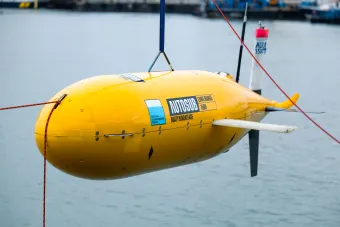
From Argo floats and self-propelled gliders to Autonomous Underwater Vehicles, such as the NOC-built Autosub Long Range (ALR) and ‘Boaty McBoatface’. These platforms can collect data from beneath the ocean surface in all conditions and operate for extended periods without any human presence.
They enable global, daily ocean monitoring and allow researchers to push boundaries. It’s vital that the next generation of marine researchers are equipped to be able to fully exploit the potential offered through these improving technologies.
NOC is creating a free online training course called APART (Autonomous Platforms as a Research Tool) to enable year 1 and 2 PhD candidates to have a strong introductory grounding in the use of Marine Autonomous Systems (MAS) for oceanographic data gathering.
After successfully completing the course, participants will gain a deep understanding of:
The technical and operational features of a wide range of MAS, including gliders, floats, and AUVs.
The scientific advantages and limitations of MAS when integrated with conventional and emerging sensor technologies.
The capabilities of MAS supported by NERC through the National Marine Equipment Pool.
How to design and plan effective MAS research campaigns and deployments.
The full data management lifecycle at the Data Assembly Centre, covering key processes, standards, and roles that ensure data quality, interoperability, and stewardship.
Practical techniques for processing datasets collected during MAS deployments.
In addition to theoretical learning, the course offers practical modules that enable participants to:
Evaluate the suitability of ocean gliders for specific research objectives.
Design and plan glider missions, considering scientific goals and operational constraints.
Identify and access existing glider datasets relevant to their research.
Process and analyse recovered glider data to extract meaningful scientific insights.
Prepare oceanographic datasets from ALR AUVs for publication, including calibration, mission design, cross-referencing with satellite data, and contextual integration.
Distinguish between Real-Time (RT), RT-adjusted, and Delayed-Mode (DM) data across different platforms.
Identify key sensors and samplers used in autonomous platforms and understand the variables they measure, such as CTD, oxygen, fluorescence, pH, and nitrate.
Assess sensor selection criteria based on scientific and operational needs.
Understand the role of NOC/OTE technologies in integrated ocean observing systems.
Appreciate the importance of sensor calibration, validation, and traceability in ensuring high-quality oceanographic data.
Recognise how sensor performance influences data processing, quality control, and downstream data workflows.
Who can apply?
We have two programmes running in 2026, across two weeks.
The first programme is designed for PhD students, with a second programme set for early career researchers. If places remain, they will be available to those working in the UK in a sector aligned with UKRI science.
Applications are open until the end of November.
Find out more: Training course: Autonomous Platforms as A Research Tool (A.P.A.R.T) | National Oceanography Centre