|
Posted: 19 April 2024
 Last week a team of scientists and ocean experts represented the National Oceanography Centre (NOC) at the UN Ocean Decade conference, to support and promote global ocean science and action.
The conference, hosted in Barcelona from 10–12 April, took place three years after the start of the...
Last week a team of scientists and ocean experts represented the National Oceanography Centre (NOC) at the UN Ocean Decade conference, to support and promote global ocean science and action.
The conference, hosted in Barcelona from 10–12 April, took place three years after the start of the... |
|
Posted: 12 April 2024
 Our scientists will be representing NOC at the EGU General Assembly (14–19 April 2024) which brings together geoscientists from all over the world to one meeting covering all disciplines of the Earth, planetary, and space sciences.
The EGU aims to provide a forum where scientists,...
Our scientists will be representing NOC at the EGU General Assembly (14–19 April 2024) which brings together geoscientists from all over the world to one meeting covering all disciplines of the Earth, planetary, and space sciences.
The EGU aims to provide a forum where scientists,... |
|
Posted: 5 April 2024
 A study led by the National Oceanography Centre (NOC) has evaluated a potential way to remove CO2 from the atmosphere using the ocean.
Scientists used a state-of-the-art climate model to simulate the benefits of depositing olivine (a bright green mineral) sands on the seafloor.
This process...
A study led by the National Oceanography Centre (NOC) has evaluated a potential way to remove CO2 from the atmosphere using the ocean.
Scientists used a state-of-the-art climate model to simulate the benefits of depositing olivine (a bright green mineral) sands on the seafloor.
This process... |
|
Posted: 28 March 2024
 Scientists from the National Oceanography Centre (NOC) have set sail on NOC’s world-leading research vessel RRS Discovery.
This is NOC’s 20th anniversary expedition of researching the Atlantic Meridional Overturning Circulation (AMOC), as part of its RAPID programme.
This makes...
Scientists from the National Oceanography Centre (NOC) have set sail on NOC’s world-leading research vessel RRS Discovery.
This is NOC’s 20th anniversary expedition of researching the Atlantic Meridional Overturning Circulation (AMOC), as part of its RAPID programme.
This makes... |
|
Posted: 25 March 2024
 The National Oceanography Centre (NOC) and other leading UK marine scientists will be at the Summer Science Exhibition, the Royal Society’s annual celebration of cutting-edge science.
14 flagship exhibits, 33 talks, 30 hands-on activities, more than 250 scientists over six days –...
The National Oceanography Centre (NOC) and other leading UK marine scientists will be at the Summer Science Exhibition, the Royal Society’s annual celebration of cutting-edge science.
14 flagship exhibits, 33 talks, 30 hands-on activities, more than 250 scientists over six days –... |
|
Posted: 21 March 2024
 The National Oceanography Centre (NOC) has been announced as a major partner in a new £16 million centre for doctoral training (CDT).
The Mathematics for our Future Climate CDT will train graduates with mathematics, physics, and engineering backgrounds to help improve our understanding...
The National Oceanography Centre (NOC) has been announced as a major partner in a new £16 million centre for doctoral training (CDT).
The Mathematics for our Future Climate CDT will train graduates with mathematics, physics, and engineering backgrounds to help improve our understanding... |
|
Posted: 20 March 2024
 Dr John Siddorn will officially start the role of CEO of the National Oceanography Centre (NOC) on 4 April 2024, bringing with him extensive experience in leadership in science, technology and innovation.
Dr Siddorn will be replacing Professor Ed Hill CBE, who announced his retirement from NOC...
Dr John Siddorn will officially start the role of CEO of the National Oceanography Centre (NOC) on 4 April 2024, bringing with him extensive experience in leadership in science, technology and innovation.
Dr Siddorn will be replacing Professor Ed Hill CBE, who announced his retirement from NOC... |
|
Posted: 8 March 2024
 Our Marine Systems Modelling scientists are developing innovative, state-of-the-art models and use these tools to better understand and predict how our oceans work, addressing fundamental societal challenges.
For our latest Scientist Spotlight, we caught up with Marine Biogeochemist Dr Chelsey...
Our Marine Systems Modelling scientists are developing innovative, state-of-the-art models and use these tools to better understand and predict how our oceans work, addressing fundamental societal challenges.
For our latest Scientist Spotlight, we caught up with Marine Biogeochemist Dr Chelsey... |
|
Posted: 5 March 2024
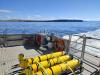 The National Oceanography Centre (NOC) and the Met Office are collaborating to gather data which will improve the accuracy of weather forecasting and generate a better analyses of the state of the North Sea.
Cutting-edge underwater gliders, operated by engineers from NOC, navigate through the...
The National Oceanography Centre (NOC) and the Met Office are collaborating to gather data which will improve the accuracy of weather forecasting and generate a better analyses of the state of the North Sea.
Cutting-edge underwater gliders, operated by engineers from NOC, navigate through the... |
|
Posted: 28 February 2024
 A study by the National Oceanography Centre (NOC) has discovered a chain of events that leads to hotter and drier European summers.
This means European weather may be predictable months to years in advance.
This study is a step forward for improving models, which will enable industries and...
A study by the National Oceanography Centre (NOC) has discovered a chain of events that leads to hotter and drier European summers.
This means European weather may be predictable months to years in advance.
This study is a step forward for improving models, which will enable industries and... |